AI in Stock Market Trading: How Traders Are Using AI Tools in 2026
-

Updated by: Vanshika Arora
-
05 Oct 2026
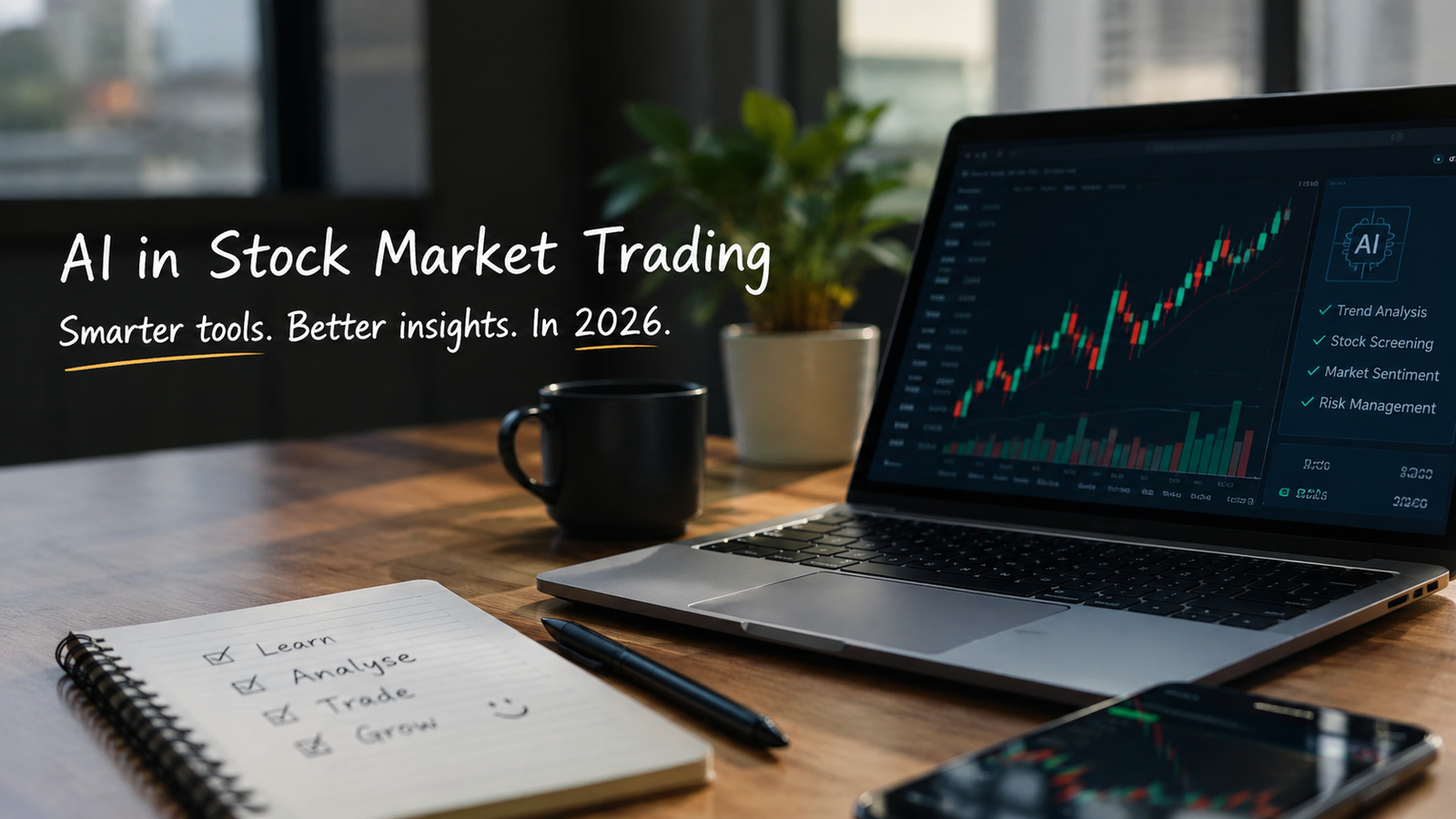
AI in stock market trading is changing how traders research markets, analyse data, and monitor potential opportunities. In 2026, traders have access to AI-powered tools that can process large amounts of market information in seconds, making tasks such as stock screening, technical analysis, and market research more efficient.
But AI is not a replacement for market knowledge. The real advantage comes from knowing how to use these tools while making independent and informed trading decisions.
How Is AI Used in Stock Market Trading?
AI can analyse large datasets and identify patterns that may take much longer to find manually. Traders are using AI tools to screen stocks, analyse price movements, track market activity, and organise financial information.
For example, instead of manually checking hundreds of stocks, a trader can use an AI-based stock screener to filter companies based on conditions such as price momentum, trading volume, or selected technical indicators.
This helps reduce repetitive research and gives traders more time to evaluate potential setups.
AI for Stock Screening and Market Research
One of the most practical uses of AI trading tools is stock screening.
AI can process historical prices, trading volumes, financial data, and other market information to create a shortlist of stocks that match specific criteria. This can be particularly useful for traders who follow multiple sectors or a large number of stocks.
However, an AI-generated shortlist is only the beginning of the research process. Traders still need to examine the company's financial position, technical setup, market conditions, and potential risks before making a trade.
How AI Helps With Technical Analysis
AI and technical analysis are increasingly being used together.
AI-powered platforms can help traders analyse charts, identify potential patterns, monitor indicators, and generate alerts when certain market conditions occur. This can save time for traders who cannot continuously watch the market during trading hours.
For beginners, however, understanding the basics of technical analysis remains important. An AI-generated signal does not automatically mean that a trade is worth taking.
Can AI Predict Stock Prices?
AI cannot accurately predict every future stock price.
Although artificial intelligence can analyse historical and current market data, stock prices are affected by many unpredictable factors. Economic announcements, company news, global events, interest-rate decisions, and changes in investor sentiment can all influence market behaviour.
Therefore, AI in trading should be treated as a research and decision-support tool, rather than a system that guarantees profits.
Why Traders Still Need Market Knowledge
As trading technology becomes more advanced, understanding the fundamentals of the stock market becomes even more important.
Traders should have a clear understanding of technical analysis, fundamental analysis, risk management, position sizing, and trading psychology before depending heavily on AI tools.
For beginners looking to develop these skills in a structured learning environment, SMTA Institute offers stock market and trading education covering important areas of market analysis and trading. A strong foundation can help learners evaluate AI-generated information more critically instead of blindly following signals.
How Beginners Can Use AI for Trading
Beginners do not need dozens of AI tools to get started. It is better to use AI for specific tasks and understand what the tool is actually doing.
Some practical uses include:
Screening stocks based on predefined conditions
Summarising financial and market information
Studying historical price movements
Supporting technical analysis
Organising watchlists
Monitoring selected market conditions
The information generated by AI should always be verified before it becomes part of a trading decision.
The Future of AI in Stock Market Trading
AI is likely to become a bigger part of the trading ecosystem in the coming years. Faster data analysis, automated monitoring, intelligent screening, and personalised research tools can make the trading process more efficient.
However, technology alone cannot make someone a successful trader. Risk management, discipline, patience, and market knowledge remain essential.
AI in stock market trading is making market research faster and more accessible in 2026. Traders can use AI to analyse information, screen stocks, monitor markets, and support technical research.
For beginners, the best approach is to learn the fundamentals first and use AI as an additional tool. Understanding the market while knowing how to use modern technology can help traders build a more informed and disciplined approach to trading.